Story by Lucas Amoroso-Whittles, Lindsy Figueroa, Michelle Velez and Marcus Saunders
For Socrates Adamakis, an 18-year-old architecture student from Athens, Greece living in Florence for close to a year, admiration of the city’s history and identity drew him to moving there, despite the flood of tourism and short-term rentals.
“Every street is a museum,” Adamakis said, describing why he left Athens for Florence. He noted that Athens lost much of its architectural character during the economic crisis, with historic buildings replaced by concrete. Florence, he argued, never let that happen.
“They’ve preserved it really well. I think it’s one of the top preserved cities in Europe, at least. You will never see a new modern building here.”
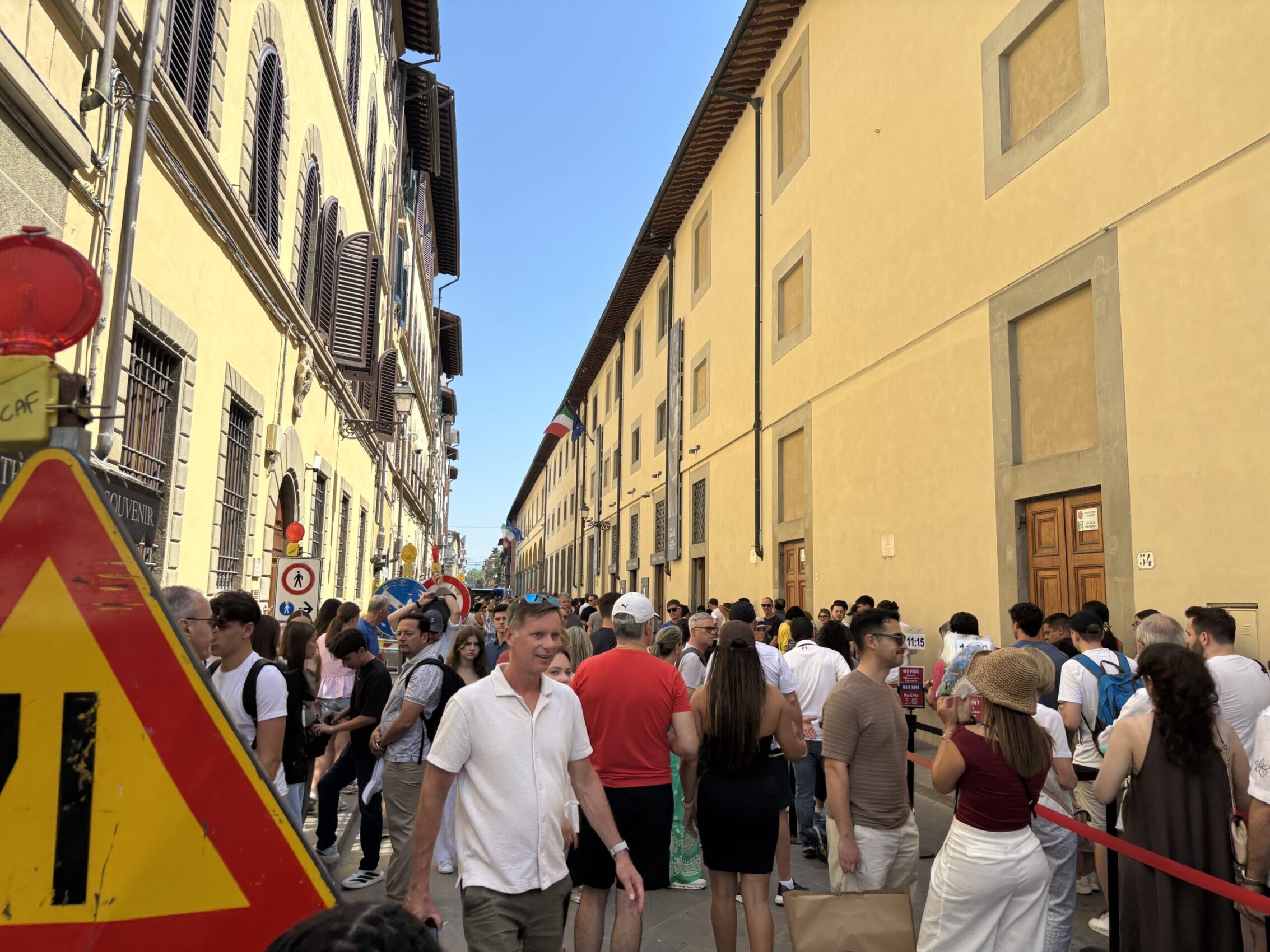
Florence is struggling with mass tourism as visitor numbers climb across both Tuscany and Italy more broadly. According to Italy’s national statistics institute, tourism reached record highs in 2024, with 466.2 million overnight stays nationwide, driven by foreign visitors. Florence alone welcomed an estimated 16.2 million visitors in 2024, surpassing pre-pandemic levels and reinforcing its status as one of Italy’s most visited cities.
At the same time, short-term rentals have expanded rapidly throughout the city. Florence officials said the number of Airbnb-style apartments in the historic center grew from fewer than 6,000 in 2016 to nearly 14,400 by 2023 according to municipal data cited in Reuters reporting. Officials and housing advocates said the growth has intensified pressure on rents and long-term housing availability.
The city has increasingly become economically dependent on tourism. Tuscany recorded more than 52 million overnight stays in 2023, with international tourism accounting for nearly all of the region’s growth. Foreign tourism in Italy now represents over half of all tourist demand nationwide, while domestic tourism has largely stagnated. That dependency has intensified concerns that housing and local businesses are being reshaped primarily around short-term visitors rather than residents.
In response, Florence has moved to regulate mass tourism more aggressively than many other Italian cities. In 2024, it became the first city in Italy to ban new short-term rentals within its historic center, with officials arguing that the growth of about the difficulty it creates, particularly for young students and workers trying to settle.
Adamakis described spending a month bouncing between Airbnb’s with his sister before stumbling across a student housing agency by chance. His current room, split with a Greek classmate, costs €800 each per month, a price he was told to consider himself lucky to have found.
“You can’t find any cheaper houses, it’s so hard.”
He also described widespread scams in the online listings market, where reverse image searches revealed that advertised apartments were photos of homes in Milan, Rome, or other countries entirely, a sign of how distorted the rental landscape has become.
Adamakis explained that he does not see tourism as the threat, noting that he draws a clear line between the tourist center and the rest of the city.
“If you walk 10 minutes away from the Duomo, there’s no tourists, only locals.”
He arrived determined not to stay within the tourist circuit, spending his early months cycling down unfamiliar streets in search of local restaurants, bars, and supermarkets. That effort, he said, paid off.
“The tourist traps are only in the very central areas, the Duomo, Palazzo Vecchio, Piazza della Signoria, but yeah, everywhere else, it’s traditional and local.”
For Adamakis, Florence is managing the tension between tourism and tradition better than most. The architecture is protected, the neighborhoods outside the center remain authentically
Elisabetta Licitra of Destination Florence said that the issues around housing are a local and national issue for both students and residents, noting that many people have chosen to rent their properties out on sites like Airbnb, rather than to Florentines.
“This creates, of course, a huge problem,” Licitra said. “Because you have to imagine that in a building of, for example, six apartments in the city center, maybe there is one resident, one Florentine, and then the rest of them are Airbnb’s,”
Licitra said that the city has tried to regulate the issue but was almost stopped by the Italian government due to limited city powers. Licitra explained that the goal is to spread tourists around the city, beyond popular destinations, through methods such as transportation services to other locations within Florence.
“The aim is to not then try to develop new hotels, new accommodation in order to spread the people all over the destination,” Licitra said.
The workers weigh in
For the servers at Florentine restaurant Caffe Condotta, the relationship between the historical Italian city and its tourists is not complicated. It is survival.
“We live off tourism here. If there’s no tourism, we don’t eat,” said one server, originally from Cuba, when asked how dependent her business is on visitors. She said that two or three months out of the year, when tourist season slows, the restaurant quiets and the staff takes their vacation. The rest of the year, they work.
That rhythm, she said, is not unique to her workplace. “That works for everyone, not just us. The whole city is like that, well, not the whole city, but it’s certain.”
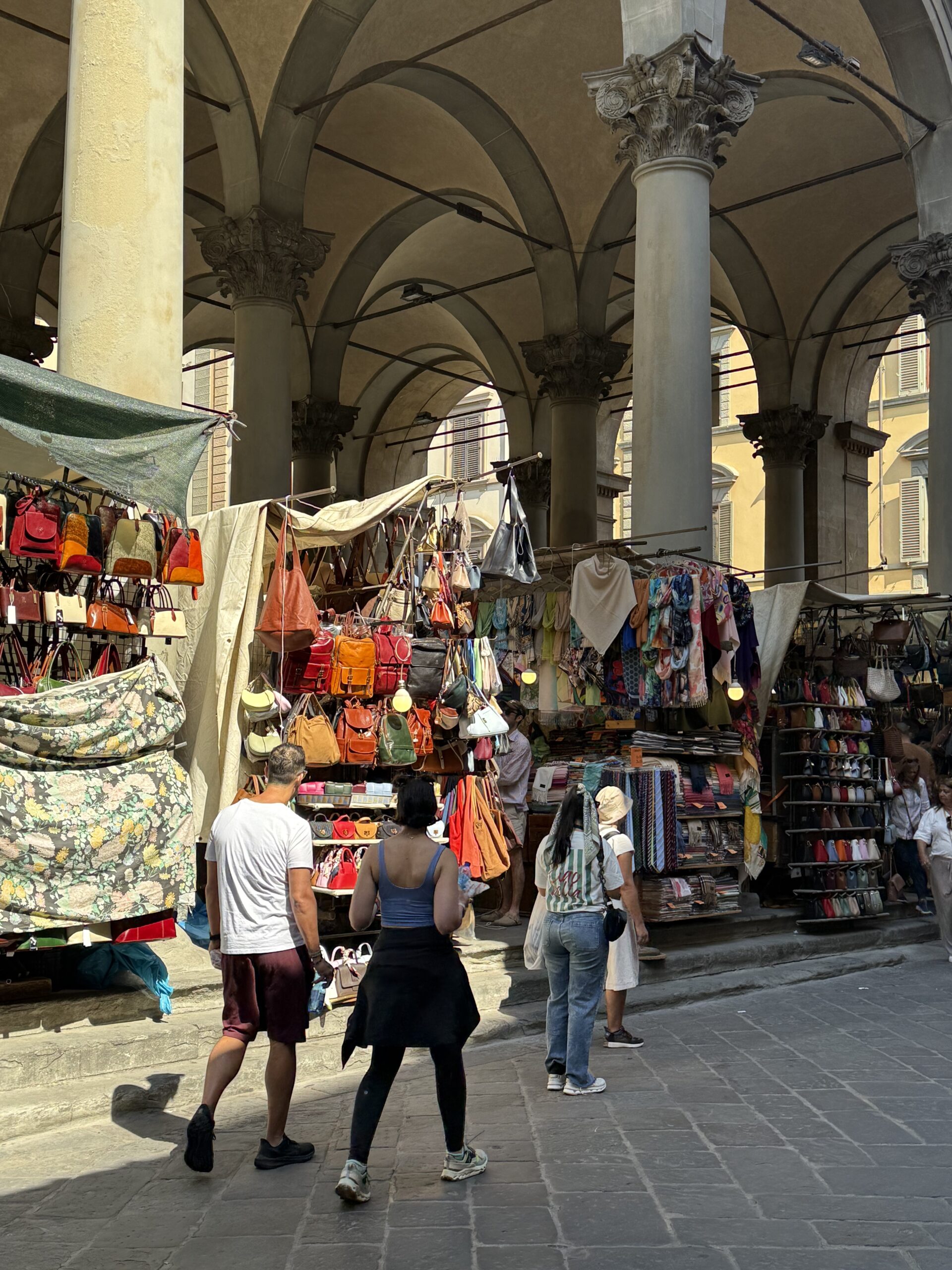
When asked whether tourist trends had changed the way the restaurant operates, she pointed to nationality as the bigger variable. American tourists, she said, are the easiest and most enthusiastic customers. “They are interested in everything. Any store selling anything ‘Made in Italy’ will do. You can sell whatever you want, and it will sell.” European tourists, she said, are more selective.
Americans have become especially important to Florence’s tourism economy. The United States is now one of Italy’s largest foreign tourism markets, while American Travelers consistently rank among the country’s highest spenders per trip. Florence’s luxury retail sector and restaurant industry have increasingly adapted toward international demand, particularly from North American travelers seeking luxury shopping, wine tourism, and cultural tourism experiences.
On the question of whether traditional businesses have disappeared because of tourism, she was initially dismissive, turning to a coworker in disbelief. Her coworker, who has been in Florence since 2009, offered a more measured answer. Yes, some have closed, she said, but something always comes to replace them. The concern, though, is what exactly is doing the replacing.
“Right now, it is not as authentic as it was before,” the coworker said. “Everything has changed completely.”
A third coworker agreed, noting that crime has increased and that the center of Florence has shifted away from Italian ownership almost entirely. “There are practically no Italian businesses in the center of Florence. They are mostly foreign owned.”
The first coworker laughed at the irony, gesturing to herself and her colleagues. “Us!”
Beyond Florence: How Global Pushback is Reshaping Mass Tourism
Studies by local business associations have shown a steady decline in traditional artisan shops and family-owned businesses in Florence’s center over the past decade, replaced increasingly by souvenir stores, short-term rental services, and internationally owned businesses catering to tourist demand. Critics argue the shift risks turning the historic center into what some residents describe as an “open-air museum” built more for visitors than for daily Florentine life.
Elisa Reale is a local food truck worker. She has a main location in Florence and moves the truck near Artemio Franchi Stadium when events are going on.
Reale said that she has not realized the mass tourism in Florence until the last three to four years. She believes that the city is not seeing a decline in traditional business in Florence.
“No, [we] are seeing more [shops],” she said. “Because there is more tourism, more shops and more restaurants.”
Reale also works in a shop in the center of Florence, and while she believes that the city isn’t losing the culture due to the influx of tourists, she understands why there are so many stores in downtown Florence that try to appease tourists.
“If you open up [a business] outside of downtown, you work with just Italian people,” she said. “But if you want to open downtown, you know [that about] 90% of people you work with are tourists.”
She doesn’t necessarily see increased tourism as a bad thing and thinks it just depends on the people.
“[Some] that come by are good tourists, and others make a little bit of a mess,” she said. “But more or less it’s a good thing.”
The tourist perspective
Vojta Nekarda, a tourist from the Czech Republic, has been in Italy for the past four months but is visiting Florence for the first time. Nekarda decided to visit Florence because of the Uffizi Gallery, which contains many famous paintings.
Nekarda is also a member of Erasmus Milano, a study abroad and exchange experience in Milan, Italy. He has been part of Erasmus Milano since January 2026, which gave him the ability to research Florentine culture before he arrived.
“The culture I know is quite good because I lived in Italy now for four months,” he said.
Although it was only Nekarda’s first day in Florence, he praised what the city has to offer.
“[Florence is] really good, good means of transportation, and it’s not that big of a city,” he said. “It’s nice that you can walk to all of the places; so far I’m very happy here.”
Nekarda said that he would recommend that other tourists visit Florence, with his top place being the Uffizi Gallery.
What attracted Luke Krivosh, a Kent State University student, to Florence was his passion for the Renaissance. He thought it was a great idea to visit Florence since it is one of the many things the city is known for. He also was already familiar with Italy, which helped make his decision easier.
He is a big fan of the Florentine culture and hopes he can embrace it as a tourist.
“I think [the culture] is great,” he said. “Everyone’s really polite, the food is amazing [and] the art is amazing.”
He also made sure to do research on Florence so he didn’t enter the city as a blank slate. Early on in his planning he focused on the Renaissance but then later looked into places to dine and transportation in the city. Krivosh is staying in an apartment with two other students for a little over a month.
Hospitality and tourism in Florence
Two residents of Florence and Tuscany spoke on how the drive for tourism affects the city, benefits it, and perspectives on what could be a different attitude to how time is spent by tourists.
Francesco Olmi, originally from Scarperia, spoke about how Italian culture in Florence is being consolidated and marketed to tourists through businesses.
Most residents in Florence live on the outskirts of the city center due to UNESCO protections on the city center and historic buildings, Olmi said, which create limitations on building or modifying housing stock.
Olmi used the Tuscan town of San Gimignano as an example of how mass tourism is displacing locals. He said that he knew people who ended up moving to the nearby city of Siena, with prices increasing due to the tourism industry.
“One friend of mine has a small shop [in San Gimignano] where he sells necessities, things like toothpaste, pasta and all sorts of things,” Olmi said. “Just tourists go there, there is no one living inside the city.”
Olmi said that he believed package tours, such as master classes or walking tours, sell Italian culture as a product rather than a true experience.
“We are marketing our parents and our families to get more money, and I believe that is a bit aggressive. It’s not the tourist’s fault,” Olmi said. “A responsible tourist who understands [that] if I sell a product with my grandmother who is making fresh pasta, perhaps the real grandmother who makes real fresh pasta is not going to speak English very well.”
Olmi noted that the most authentic cultural experiences in Florence are going to be found by mixing with locals and going beyond tourist destinations, noting that “real authentic experiences, you don’t find them on the list or selling point.”
“You really get to feel the life, you get to feel the whole everyday life experience,” Olmi said. “The beaten path is what you find online, [where] you find the most advertised area, which is full of people, so it’s really hard to tell you where to connect with people [in the tourist areas].”
Robin Skinner, a local who divides his residence between Florence and the nearby town of Prato, expressed a similar sentiment. Skinner said that while the tourism industry has provided job opportunities for him, the atmosphere of the tourists makes things more complicated.
“[The issue around] tourism is not that it is doing much good to the culture, everything is changing to make the experience beautiful to the tourist, without being interested in the [Florentine] citizens,” Skinner said. “In any case, Florence subsists thanks to tourists.”
Skinner noted that with the recent ban on Airbnb self-check-ins, the hope is that the city will begin to focus more on the residents, but that “in any case, not enough is being done to help the Florentines, preferring [the] tourists.”
Ultimately, Skinner said that he does not want to see culture in the city change to favor tourists and instead wants the city to focus more on residents.
Photo credit:
Katelyn Webster