Story and Photos by Colby Brennan
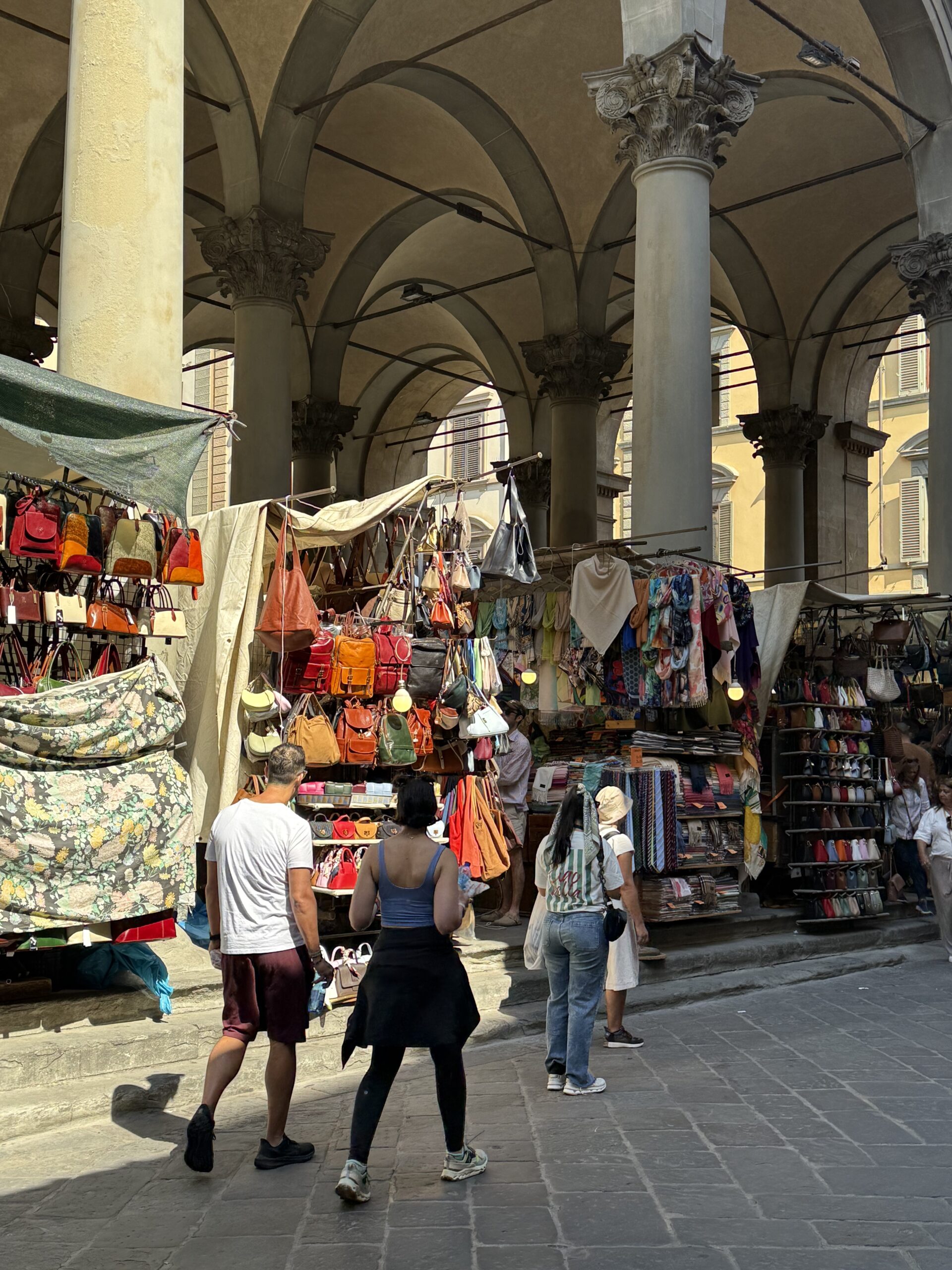
In Florence, Italy, the Ponte Vecchio has outlasted floods, wars, and seven centuries of history. Now it faces something it was never built for: ten million tourists a year.
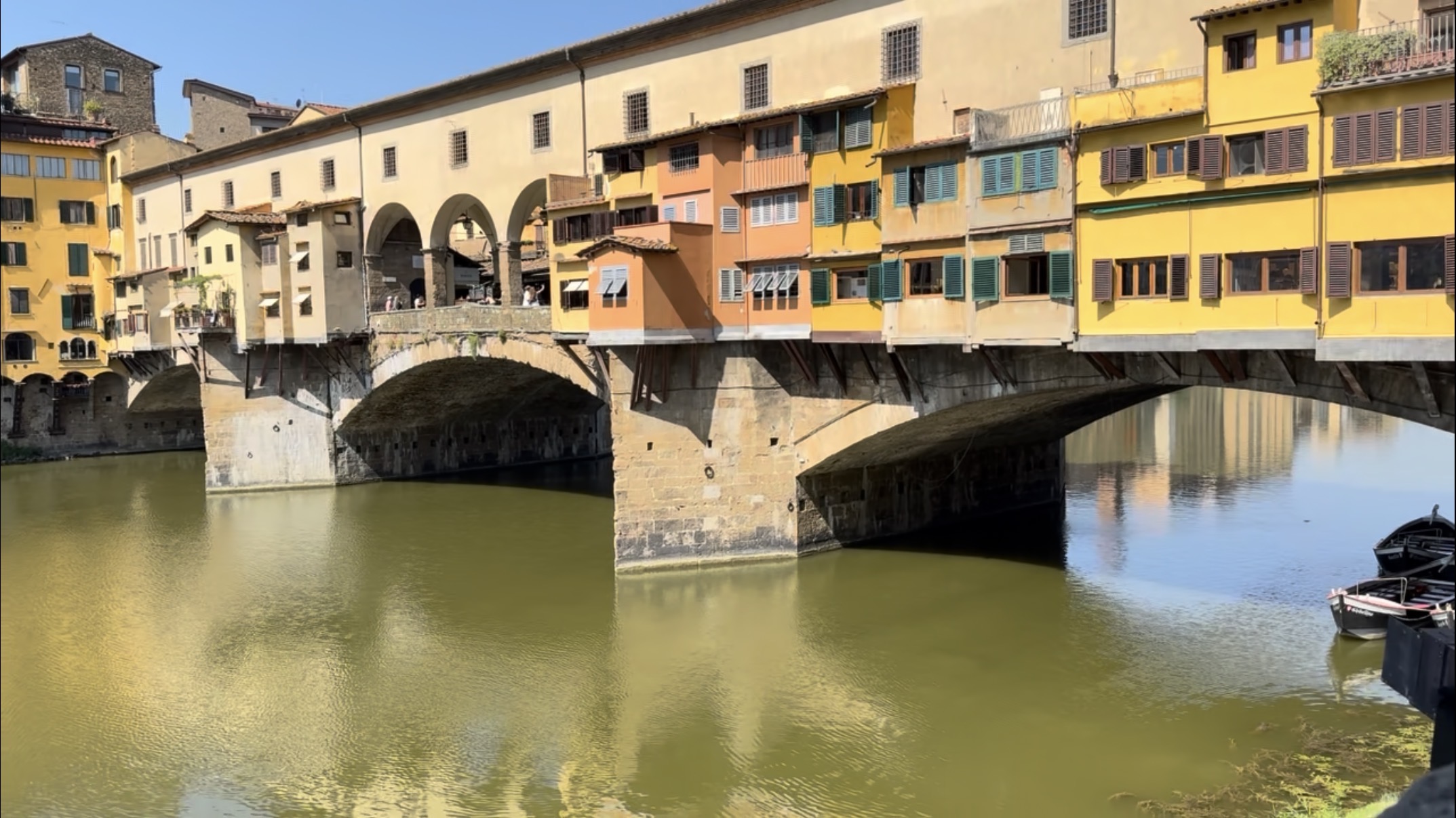
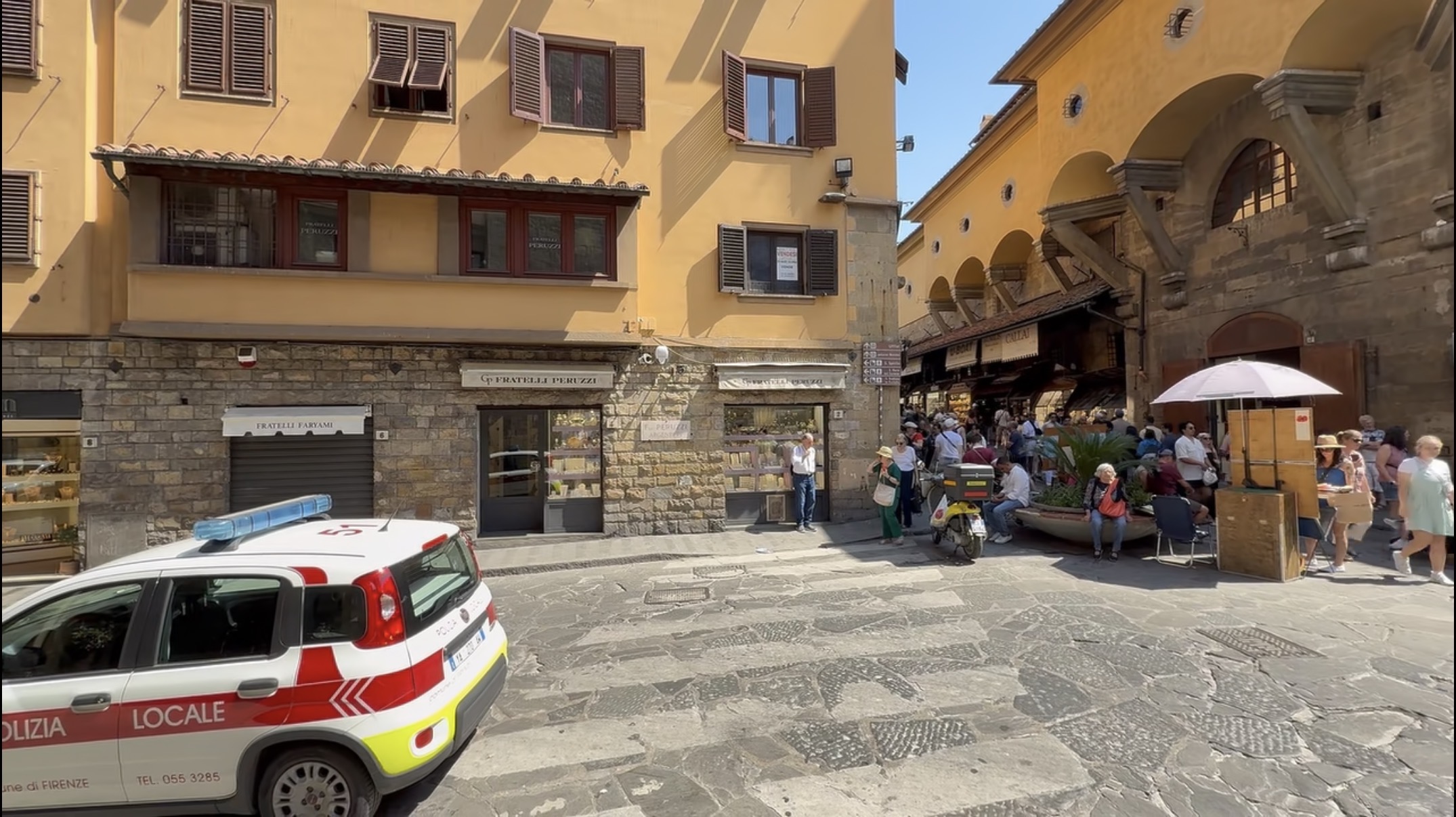
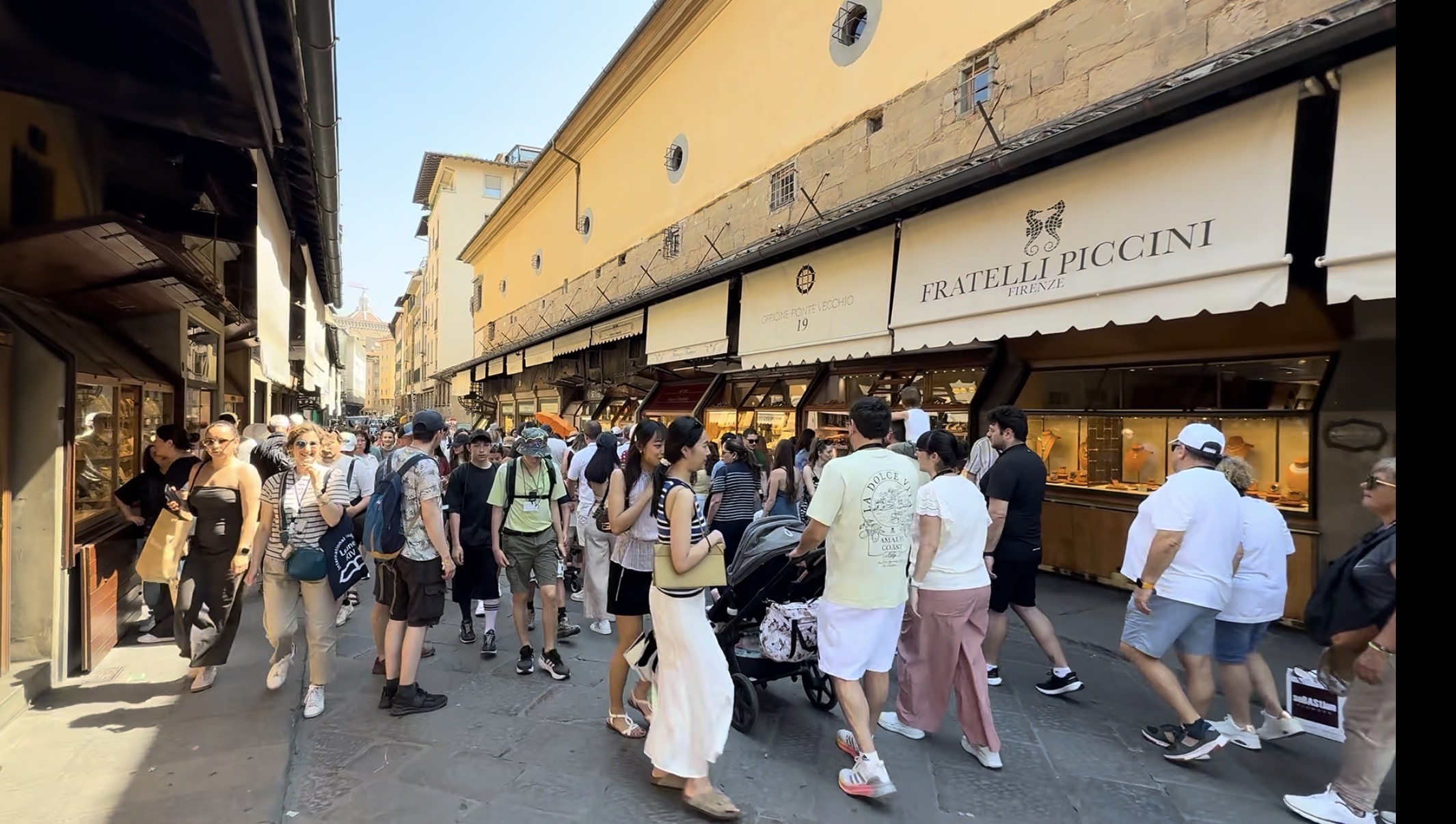
The bridge doesn’t feel like a tourist trap. It doesn’t feel like a mall. It feels like somewhere that has always existed and always will — a narrow corridor of gold and silver suspended over the Arno, where tour guides weave through crowds and shop windows catch the afternoon light off the river below.
Nobody has their phones out. People are looking, at the arches, at the water, at the jewelry glittering behind glass. There’s a liveness to the bridge that no amount of crowd data or statistics on ‘overtourism’ prepares a visitor for. But underneath that energy, something else is happening.
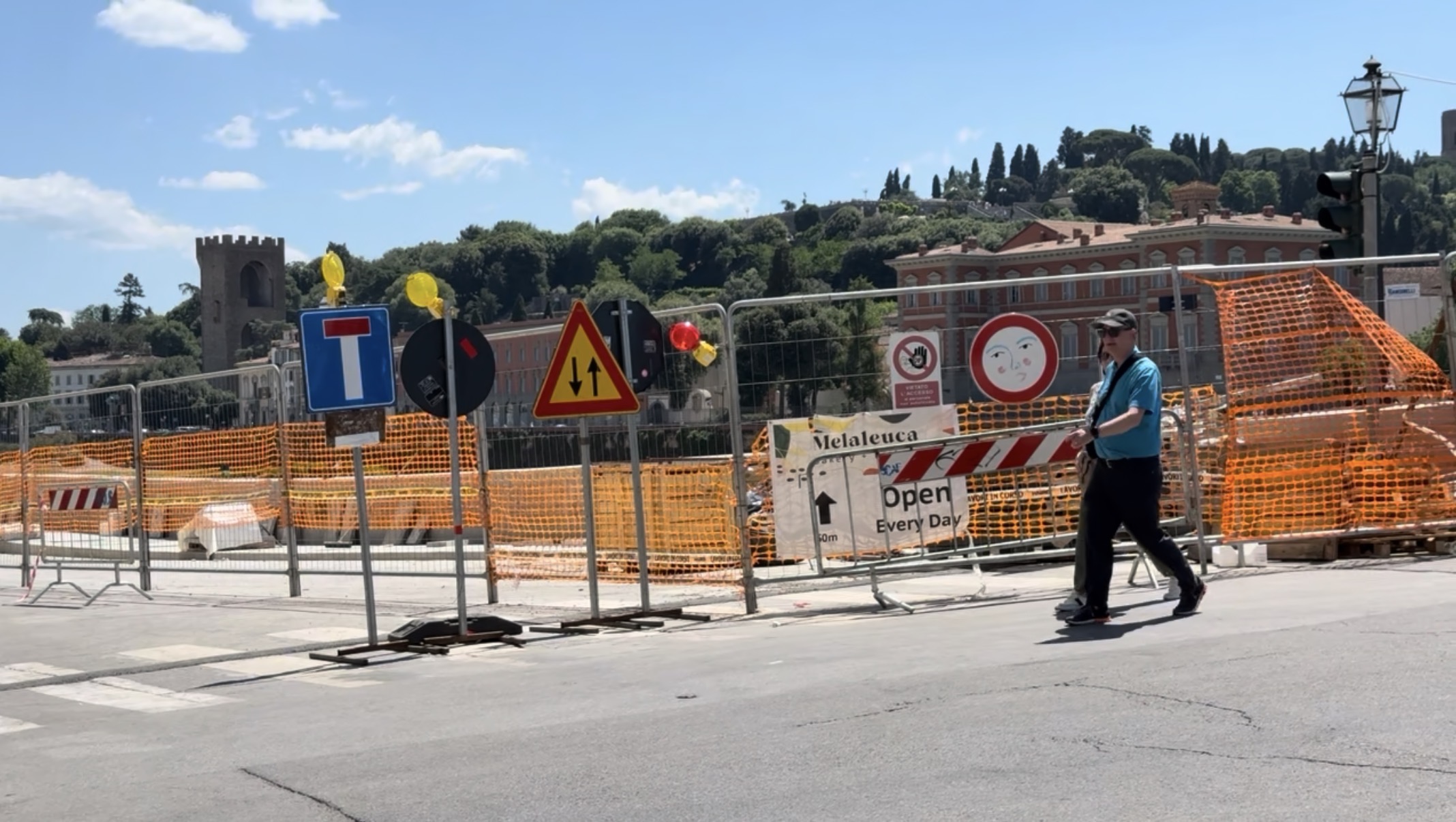
Look down at the river and floating platforms where restoration crews are working quietly beneath the surface — washing away centuries of algae, moss, and chemical deposits from stone pillars that have held this bridge together since 1345. It’s the first major restoration in the bridge’s 700-year history, a two-year, two-million-euro project that began in 2024 and is actively ongoing.
“The bridge isn’t broken, thank goodness, but it is tired,” said Gianna Peruzzi, whose family has operated a silversmith shop on the Ponte Vecchio since 1880. “It has been carrying the weight of the entire world on its shoulders for centuries.”
The Ponte Vecchio has survived floods and the Nazi retreat in 1944, when every other bridge in the city was destroyed. For seven centuries, it asked for nothing in return. Now, for the first time, it’s asking.
Florence receives more than 10.5 million visitors a year in a historic center smaller than two square miles, about the size of New York City’s Central Park. 25 tourists for every resident. The city’s population has dropped by 148,000 people since 2000 as housing costs price out the people who actually live there. In 2024, Mayor Sara Funaro announced a Ten-Point Plan banning key boxes, golf carts, loudspeakers for tour guides, and outdoor dining on 50 streets including the Ponte Vecchio area.
Sandy Chen, a tourism management professor at Ohio University, said the restoration itself is the clearest signal yet of sustained tourist pressure costs as a historic landmark.
“Restoration after 700 years isn’t just about age,” Chen said. “It reflects a mismatch between historical design limits and modern tourism volumes.”
The financial structure of the restoration reinforces that point. Approximately half the two-million-euro cost is being funded not by the Italian government but by Marchesi Antinori, one of Italy’s most prominent wine families. It’s a pattern playing out across Italy’s most iconic sites. Tod’s funded the Colosseum restoration, Diesel funded Venice’s Rialto Bridge, private money filling the gap left by shrinking public preservation budgets.
Leah Glaser, a Central Connecticut State University history professor with an expertise in historic preservation, put the stakes of that equation simply.
“The greenest building is the one that is already built,” Glaser said.
For the families who have worked on the Ponte Vecchio for generations, the restoration isn’t a disruption. It’s a necessity.
Peruzzi runs Officine Ponte Vecchio, a silversmith shop that has kept the craft of traditional Florentine metalwork alive through every chapter of the city’s modern history. She doesn’t resent the tourists. She needs them.
“Those tourists are not our enemies,” she said. “They are the very reason our traditional Florentine crafts are still alive today. Without the world coming to this bridge, the art of the silversmith would have faded away long ago.”
But she is clear about the paradox. “We want to share our heritage, but we cannot let the heritage wear away beneath the feet of the people who come to admire it.”
A few doors down, Elisa Tozzi Piccini works in an atelier above her family’s boutique, Piccini, where her family has been crafting high jewelry since 1903. From her workbench she looks directly out between the Arno and the Vasari Corridor, literally anchored, as she put it, to a masterpiece. She has a different way of framing the same tension.
“The pressure from millions of global footsteps is what finally triggered this historic restoration,” Tozzi Piccini said. “In a way, tourism provided both the challenge and the catalyst to save the bridge.”
Two families. Combined, over 240 years on the same bridge. Both watching the restoration scaffolding from their windows. Both choose to see it not as a warning but as a promise.
Glaser said that’s precisely what’s at stake when a city fails to maintain its historic structures. Preservation, she said, isn’t about saving old things because they’re old. It’s about maintaining people’s connection to where they live and who they are.
“When people are unmoored and cut off from that sense of place, they tend not to care what happens,” Glaser said.
Florence is not adrift yet. But the numbers tell a story that the restoration scaffolding alone cannot. Seventy-two streets in the UNESCO zone are now avoided by residents due to tourism pressure, according to a 2023 study by Beatrice Del Bianco and Laura Montedoro of the Politecnico di Milano. Twenty-two historic sites within the city center have been sold to luxury developers. The population of the historic center has dropped steadily since 2001. The city is reinforcing its foundations. The question is whether it’s doing so fast enough.
“History cannot just be treated like something frozen behind glass,” Tozzi Piccini said from her atelier above the shops, the Arno visible through the window behind her. “It must be lived, maintained, and loved.”
When the scaffolding finally comes down, the Ponte Vecchio will look as it has for centuries, gold and silver suspended over the Arno, carrying the world across its back. Florence didn’t just survive the age of mass travel, as Tozzi Piccini put it. It hopes it has used it to fortify its future.